Pind Hospitality built its business around food. It started with restaurants in Pune, added deliveries, and became a business its owners understand down to the last kitchen.
Now it wants to build something that is not a restaurant at all: a 46-room hotel and wedding venue, a Punjabi village palace called the Haveli, on land it owns in Wakasai, near Lonavala. It is expected to cost ₹27.47 crore and open in September 2027. The money is already arranged through an IPO, loans from Aditya Birla Finance and profits kept in the business.
Pind has never run a hotel, and the Haveli is larger than anything it has built before. A restaurant that has a bad month can recover. A hotel carrying debt that must be serviced whether or not the weddings come has far less room for a bad month.
So the question is not whether the Haveli is a lovely idea, or even whether it can make money. It is whether Pind made the smart capital decision. ArthaVeda views the decision in two steps: did Pind raise the money sensibly, and is the Haveli a sensible place to put it? The answers are not the same.
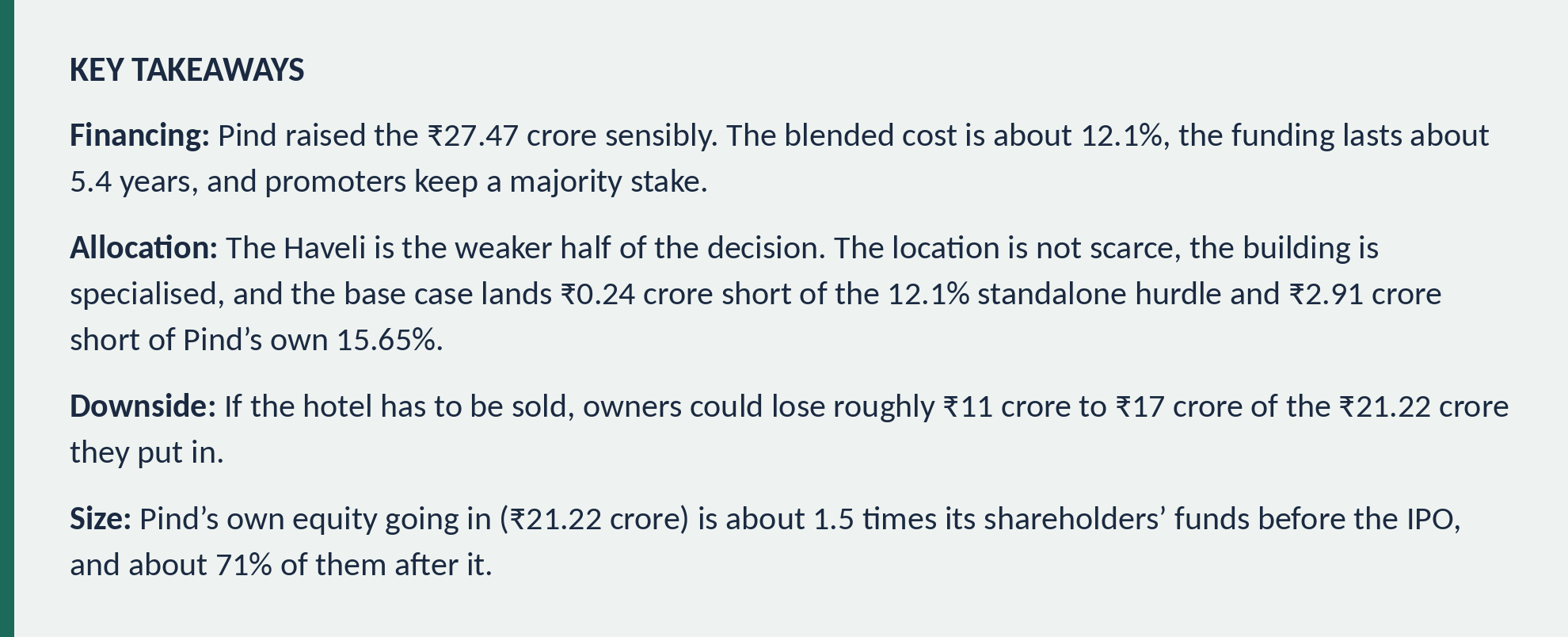
Key takeaways box covering Pind’s financing, Haveli allocation, downside risk and equity size.
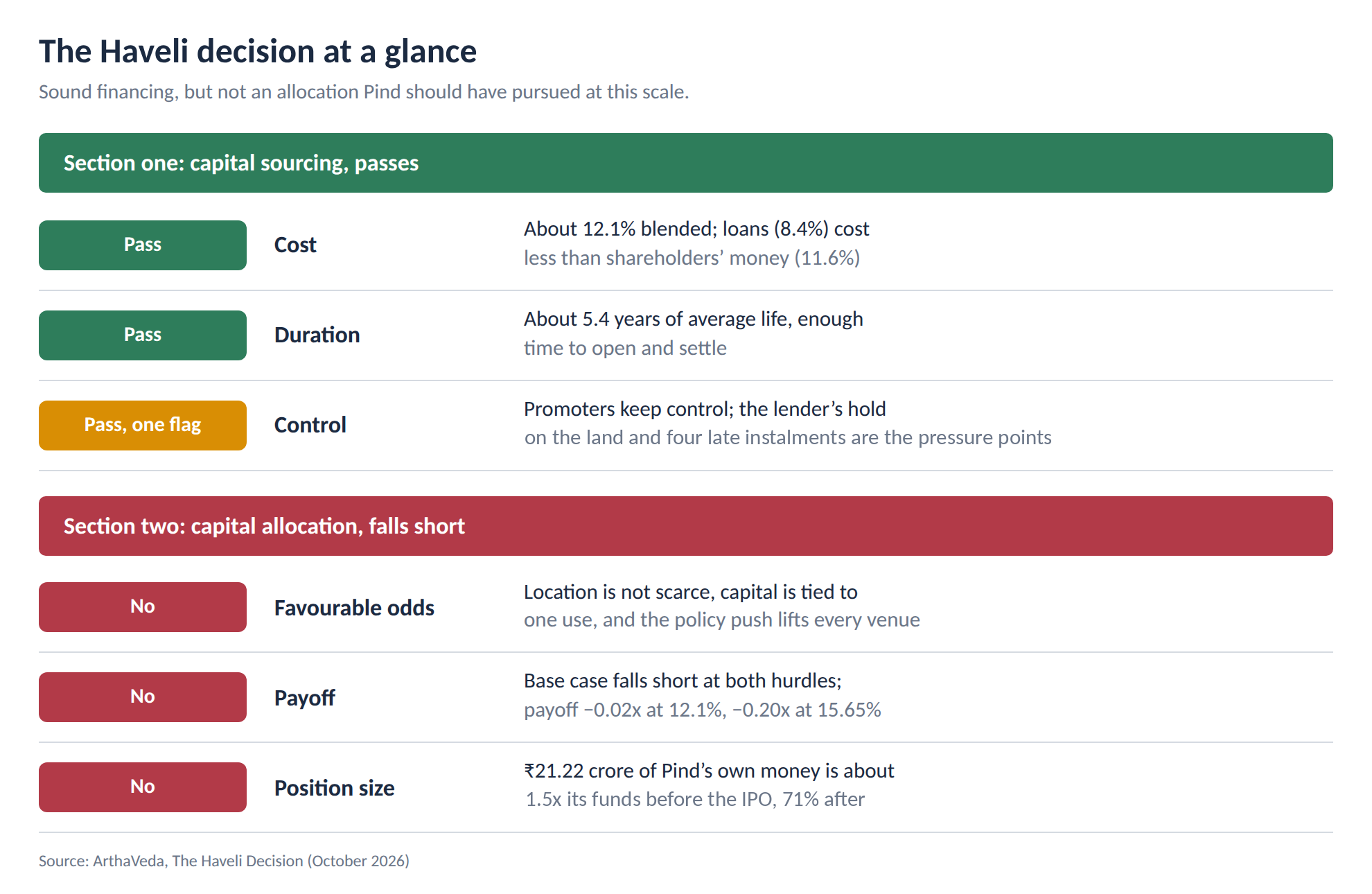
A scorecard of the Haveli decision: capital sourcing passes (with one flag on control), while capital allocation falls short.
Capital Sourcing
Cost of Capital
The ₹27.47 crore project is funded from three sources: ₹12.70 crore raised through the IPO, ₹6.25 crore in loans from Aditya Birla Finance, and ₹8.52 crore from Pind’s retained earnings. Each source has a different cost, time horizon and set of constraints.
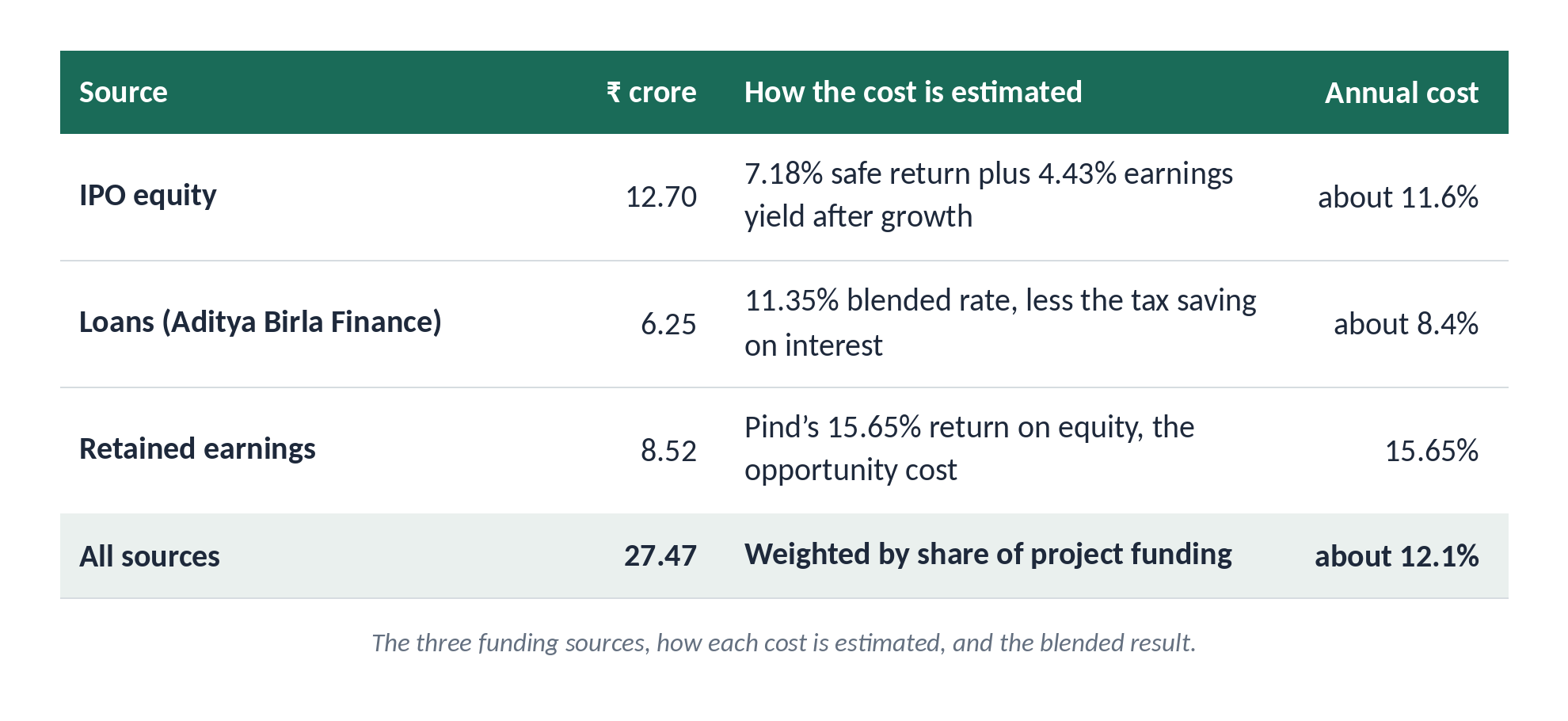
A table of Pind’s ₹27.47 crore funding by source, how each cost is estimated, and the blended annual cost of about 12.1%.
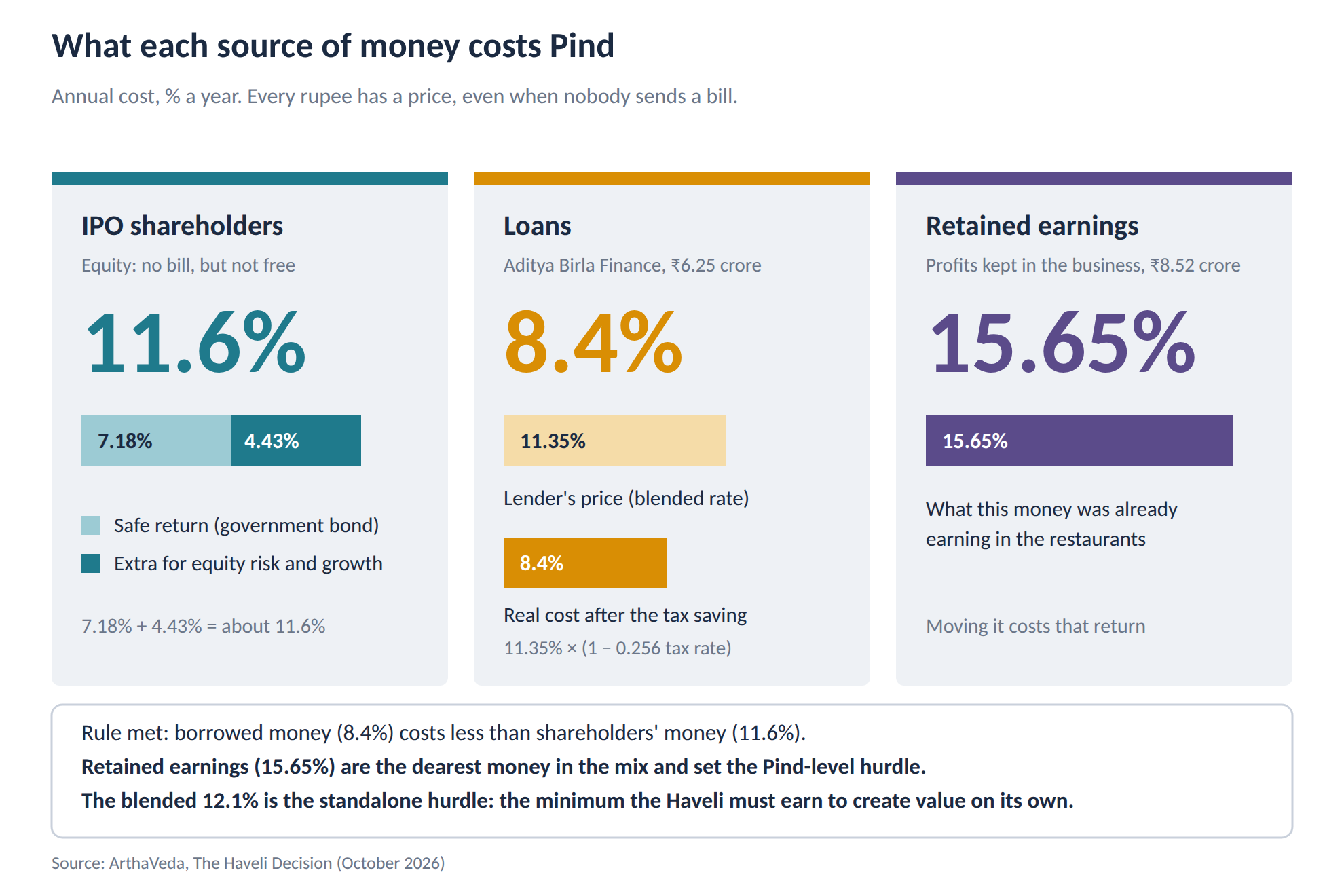
A three-panel graphic of what each source of money costs Pind: IPO equity 11.6%, loans 8.4% after tax and retained earnings 15.65%.
ArthaVeda estimates the cost of equity at about 11.6%. Although equity does not require monthly repayments, it is not free: shareholders expect the business to earn a return on their capital. Pind priced its IPO shares at ₹99, valuing the company at ₹59.39 crore, or 26 times its annual earnings. Its earnings yield (annual earnings as a share of market value) was 3.83% last year, rising to an estimated 4.43% after accounting for growth. Adding the 7.18% safe-return benchmark gives an expected return of about 11.6%.
The loans carry a blended interest rate of 11.35%. After accounting for tax savings on interest, the effective borrowing cost is about 8.4%. This assumes the company can claim the tax benefit at the rate used in its FY26 results. The actual cost may change if its tax situation or floating interest rates change.
Retained earnings are the most easily overlooked source. The ₹8.52 crore may belong to the company, but it was already at work in Pind’s existing business. ArthaVeda uses Pind’s 15.65% return on equity as the opportunity cost, the return forgone by redeploying that money. The Haveli should therefore be judged not just against the price of borrowed funds, but against what the same capital could earn in the restaurant business.
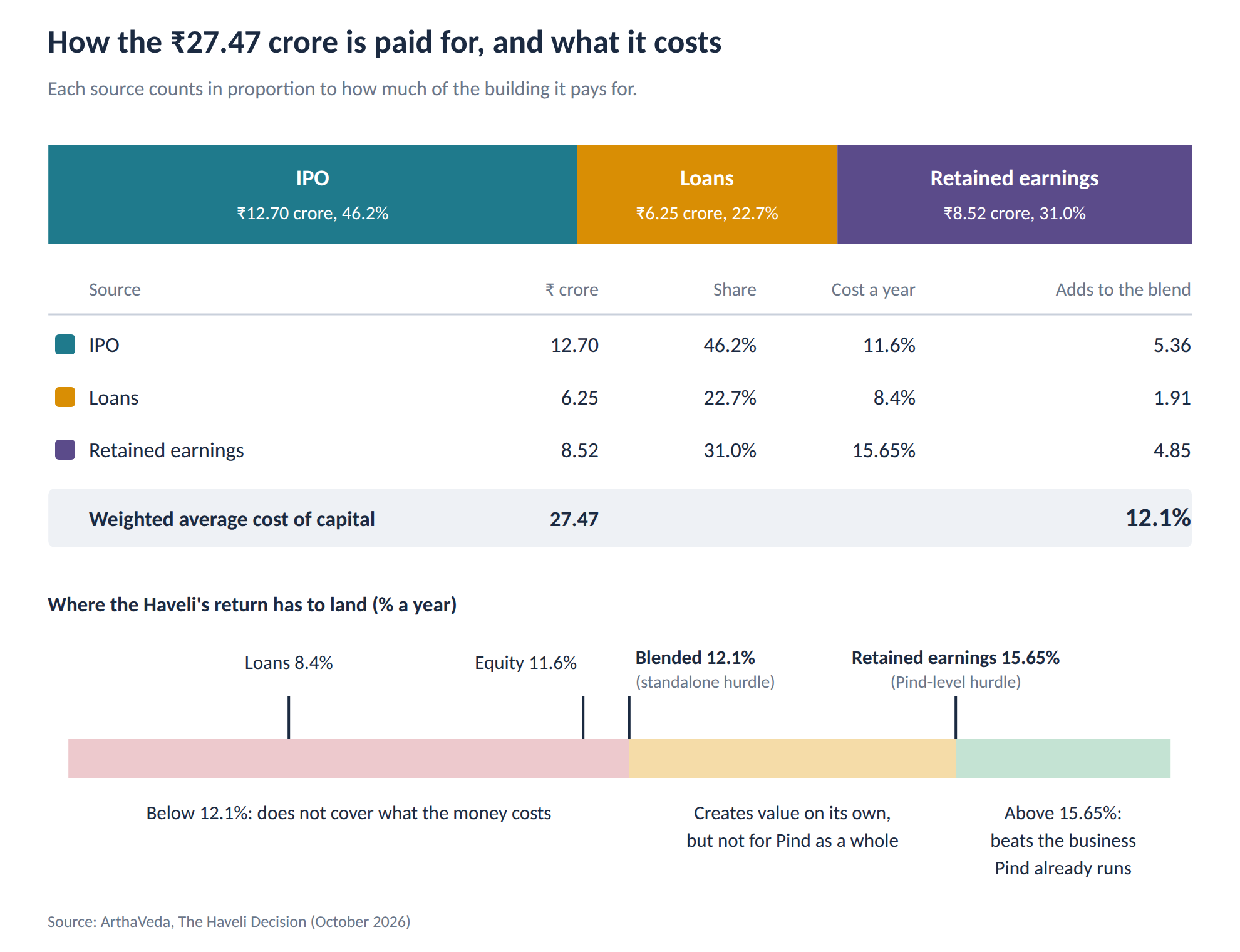
A graphic showing how Pind’s ₹27.47 crore is funded, the 12.1% blended cost, and the 12.1% and 15.65% returns the Haveli must clear.
Based on their share of project funding, the three sources give Pind an estimated cost of capital of 12.1%, the blended return its funders and shareholders require. This is the standalone hurdle: the minimum return the Haveli must earn to create value on its own. Pind’s existing return on equity is 15.65%, which makes it the Pind-level hurdle. Between the two, the Haveli creates value on its own but not for Pind as a whole: a project earning less than 15.65% could weaken the company’s overall returns even if it remains profitable.
Verdict: Cost passes. The blended cost of about 12.1% is reasonable, with loans at about 8.4% after tax against 11.6% for IPO equity. The more demanding bar for the Haveli is the 15.65% that Pind’s existing business already earns.
Duration of Capital
The timing of the capital is broadly compatible with a long-lived asset. Equity and retained earnings have no fixed repayment date; for the analysis, each is assigned a minimum five-year duration. The loans have terms of 123 and 144 months, with principal repaid monthly. Taking these repayments into account, the weighted average funding duration is estimated at about 5.4 years.
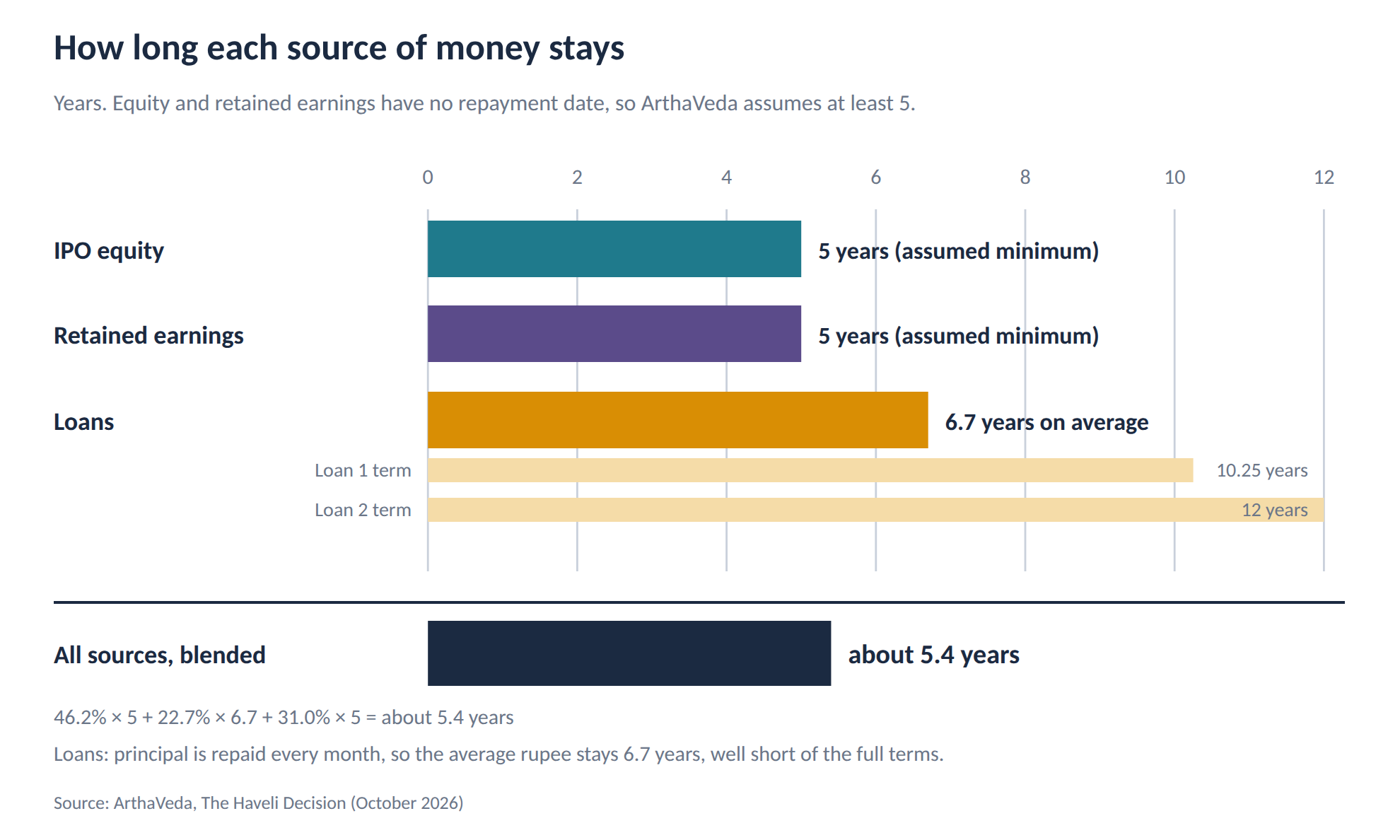
A bar chart of how long each funding source stays: equity and retained earnings 5 years, loans 6.7 years, blended about 5.4 years.
Verdict: Duration passes. The funding lasts about 5.4 years on average, with no repayment date on equity and loans running 10 to 12 years, which is long enough to build, open and ramp up the venue.
Capital Control
Control is more mixed. Promoters retain a majority stake after the IPO, and the IPO proceeds are subject to use-of-funds restrictions. The land is mortgaged, and the promoter family and a related firm are also responsible for the loans. The lender controls how funds are released and has rights if the company defaults. The prospectus also discloses that the February and March 2026 instalments on both loans were paid 86 to 88 days late, in May and June, and records them as defaults. It does not say why, and it does not disclose what could trigger early repayment or what the floating interest rate is tied to.
Verdict: Control passes, with a flag. Promoters keep control of the company, but the mortgaged land, the lender’s say over changes in use and major capital spending, and four instalments paid 86 to 88 days late limit how freely Pind can act.
Capital Allocation
Favourable Odds
A durable business has something competitors cannot easily copy. In hotels, an exceptional location can be that advantage: a property beside a landmark or on a uniquely situated site can command demand that a rival cannot reproduce simply by spending more. The Taj Lake Palace sits on its own island in Lake Pichola, and the Taj Mahal Palace faces the Gateway of India. A rival can build nearby, but not on those exact spots.
Wakasai may be a workable location, but it is not a scarce one. The area already has wedding venues and hotels serving a similar market, including Sky Resort & Lawns and 7 Apple in Lonavala. If Pind can enter the market, other operators can enter it too. A good location is not automatically a moat, the lasting advantage that keeps rivals out.
The Haveli’s design also narrows its options. The rooms, ballroom, banquet hall and restaurants are all part of the original wedding-and-hotel concept, not low-cost add-ons that open up new income streams. Much of the interior is customised, which may make it difficult to reuse for another concept without further investment.
Owning the land gives Pind some flexibility, but not complete freedom. The land is mortgaged, and the loan terms described in the offer document restrict changes in use and certain major capital expenditures without lender approval. So the asset is owned, but its future use is constrained while the debt remains outstanding.
There is a positive demand signal. India’s wedding-tourism promotion and Maharashtra’s tourism policy support the broader destination-wedding market. Yet these measures help existing venues and future entrants as well as the Haveli. They may expand the market without ensuring that Pind wins a profitable share of it.
Verdict: The Haveli does not have favourable odds. The location is not scarce, the capital is tied to one use, and the policy push lifts every venue, not just this one.
Asymmetric Payoff
An asymmetric payoff is one where the possible reward clearly outweighs the capital that could be lost. To test this, the analysis uses market-based assumptions because detailed project-level financial information has not been published. Comparable wedding packages, room rates and meal prices are used to estimate revenue, alongside assumptions about annual wedding volumes, regular room occupancy and other events. These are scenarios, not forecasts or guarantees.
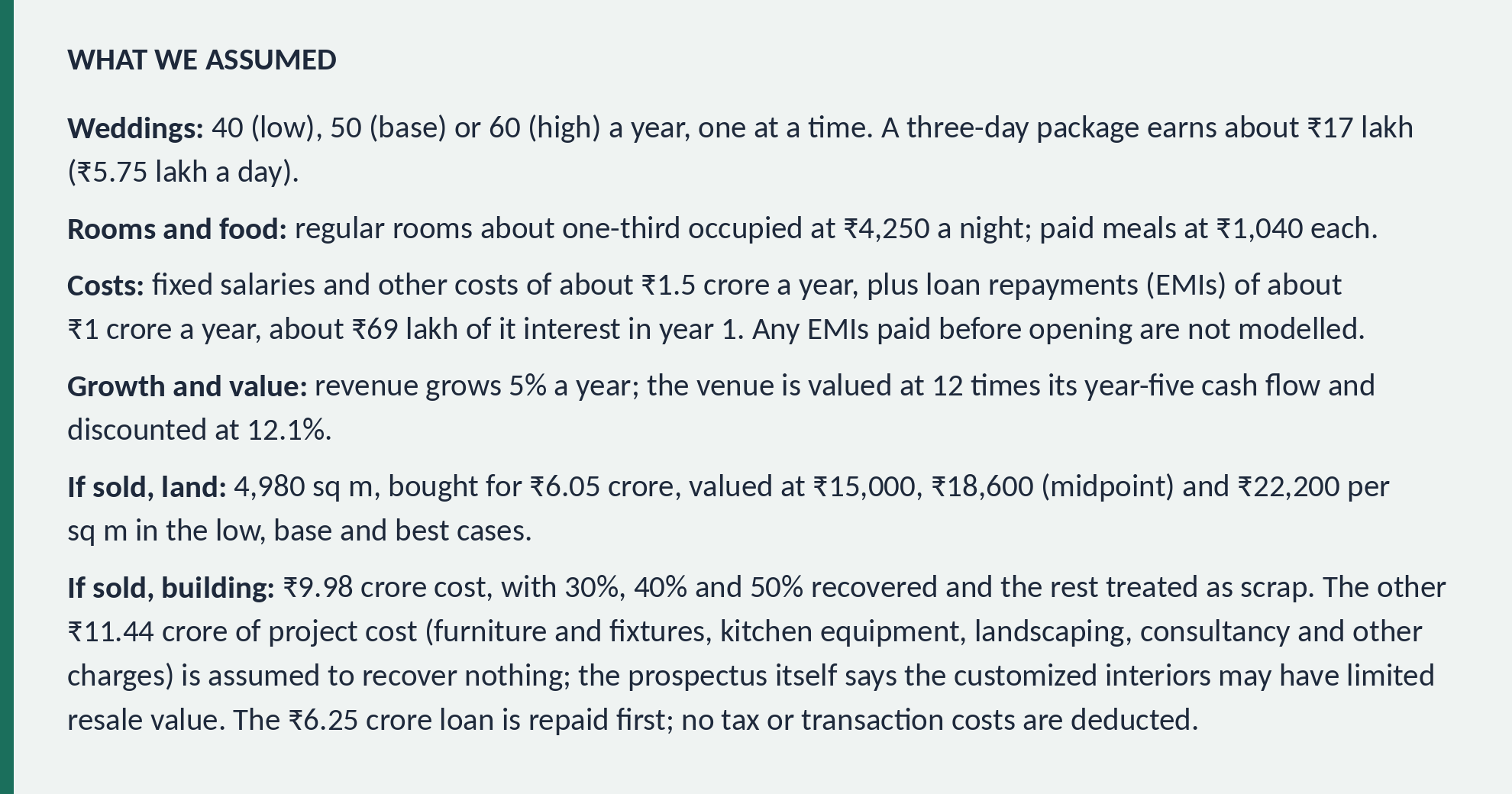
A “What we assumed” box listing the model’s inputs, from wedding volumes and costs to growth, valuation and resale values.
Cash Reward
A typical three-day wedding is estimated to generate about ₹17 lakh from the package, accommodation, meals and banquet use. Because a wedding party may occupy more than 35 of the 46 rooms, the model assumes the hotel can host only one wedding at a time. The business must therefore sell a substantial number of dates across the year, including weekdays, rather than rely on weekends alone.
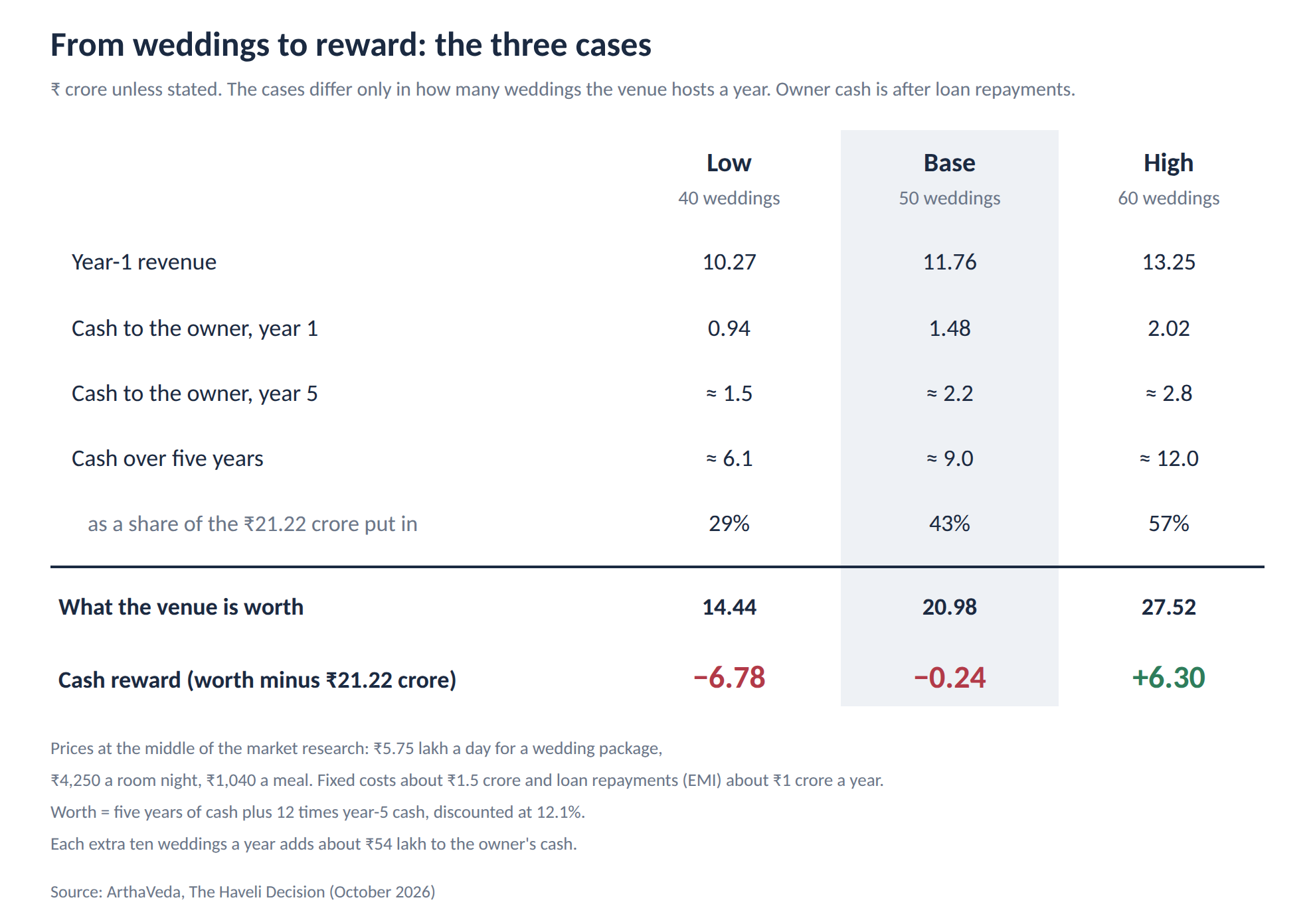
A table of the low, base and high wedding scenarios, ending in cash rewards of −₹6.78 crore, −₹0.24 crore and +₹6.30 crore.
In the base case, first-year revenue is estimated at ₹11.76 crore, with weddings contributing roughly three-quarters of the total. Revenue ranges from ₹10.27 crore in the low case to ₹13.25 crore in the high case. The model assumes that about one-third of rooms available to regular guests are occupied and that prices and other operating assumptions remain constant across the three scenarios.
Revenue is not the same as cash available to the owner. Food and supplies, staff, other operating costs, loan repayments, taxes and maintenance all need to be paid. Fixed salaries and other costs are estimated at about ₹1.5 crore annually, while loan repayments (EMIs) add roughly ₹1 crore a year, of which about ₹69 lakh is interest in the first year. These expenses do not fall in step with wedding bookings, which makes a weaker year particularly painful.
After expenses and loan repayments, the first-year cash available to the owner is estimated at ₹0.94 crore in the low case, ₹1.48 crore in the base case and ₹2.02 crore in the high case. Assuming 5% annual revenue growth, five-year cumulative cash is estimated at ₹6.1 crore, ₹9.0 crore and ₹12.0 crore respectively.
The valuation discounts future cash flows at 12.1% (the Haveli’s standalone hurdle) and assumes the venue will be worth 12 times its year-five cash flow at the end of the forecast period.
Under those assumptions, the estimated value to the owner is ₹14.44 crore in the low case, ₹20.98 crore in the base case and ₹27.52 crore in the high case.
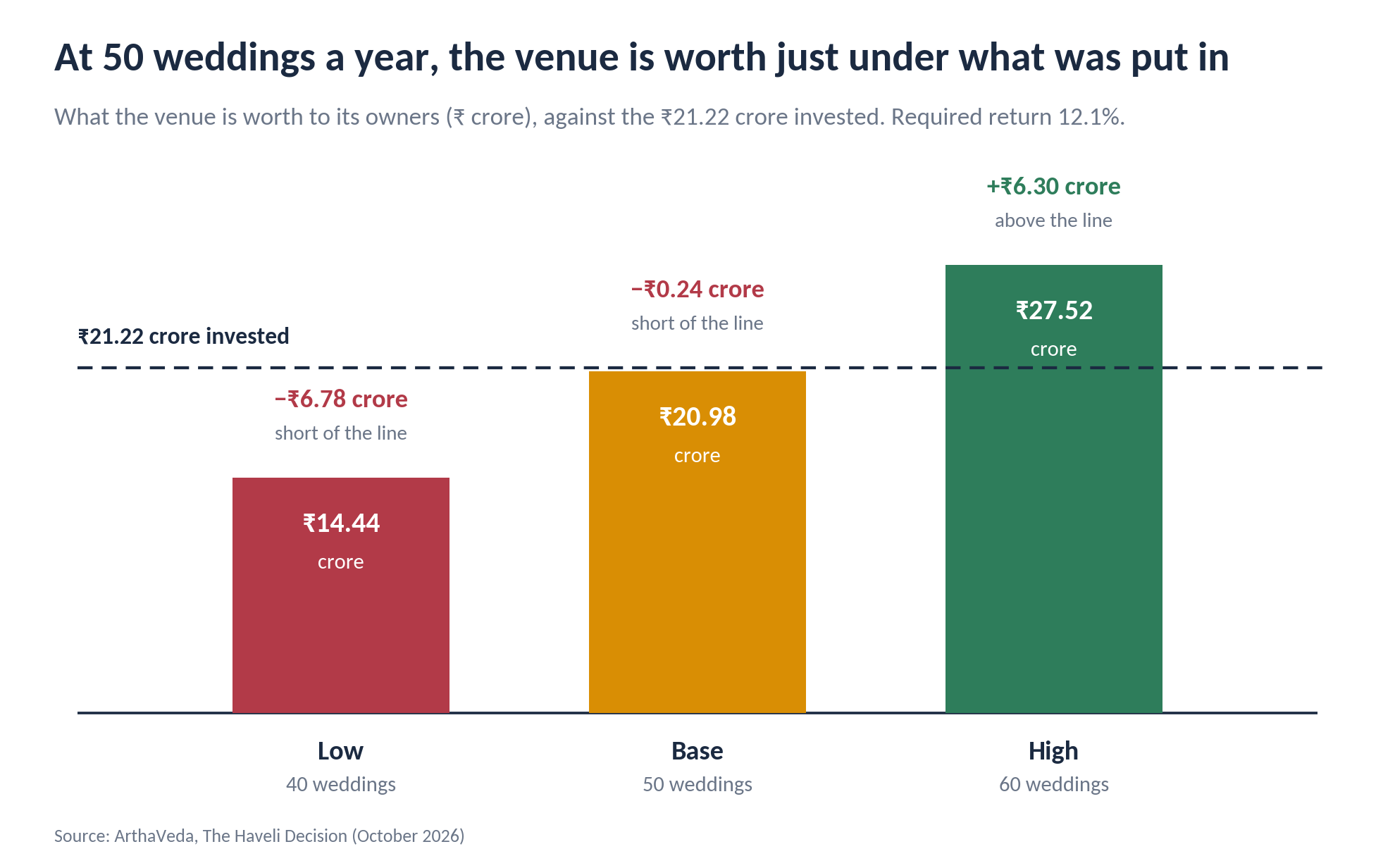
A bar chart of the venue’s worth against the ₹21.22 crore invested: ₹14.44 crore, ₹20.98 crore and ₹27.52 crore across the three cases.
Compared with the ₹21.22 crore equity contribution, the cash reward (the venue’s value minus the money put in) at the 12.1% standalone hurdle is a shortfall of ₹6.78 crore in the low case, a shortfall of ₹0.24 crore in the base case, and a gain of ₹6.30 crore in the high case. The base case is therefore close to break-even against that hurdle, not comfortably above it.
The assumptions most likely to change the answer are wedding volume, package pricing and booking duration. But that sensitivity cuts both ways: weaker demand or discounting can erode value quickly. In a harsher combination (slow bookings in the first two years, a higher required return and a lower year-five valuation), the venue’s estimated worth could fall to about half the investment.
Capital at Risk
A complete investment assessment asks what owners could recover if the hotel underperforms and the assets must be sold. A purpose-built hotel may not fetch the amount spent on construction and fit-out: a future buyer may value the land but discount a specialised building, furniture and kitchen equipment.
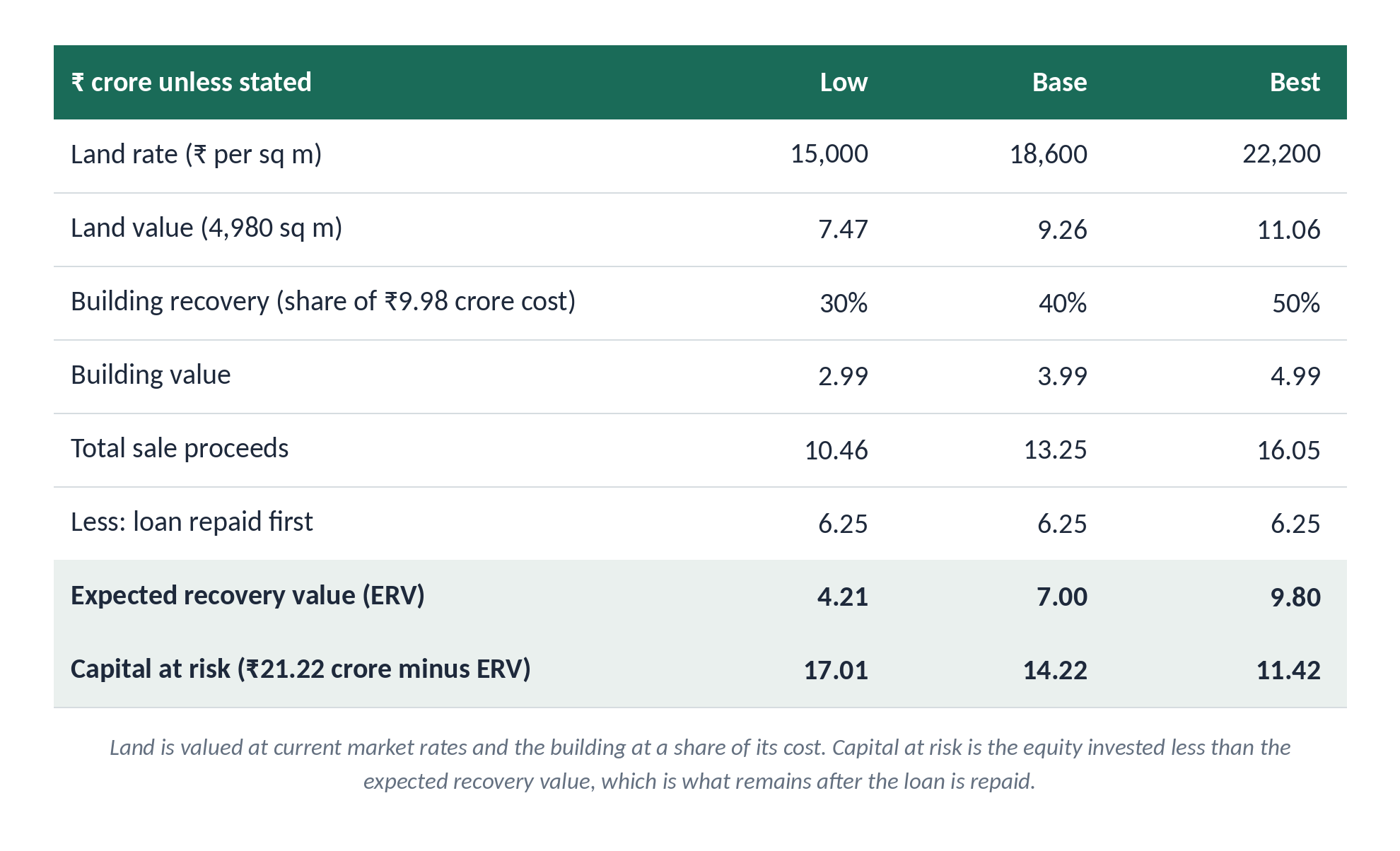
A table of what the Haveli’s land and building would fetch if sold, the recovery after the loan (₹4.21, ₹7.00 and ₹9.80 crore) and the capital at risk.
In the base case, sale proceeds are estimated at ₹13.25 crore: land at ₹9.26 crore (4,980 sq m at ₹18,600 a sq m) and the building at ₹3.99 crore (40% of its ₹9.98 crore cost). After the ₹6.25 crore loan is repaid, about ₹7.00 crore would remain for the owners. Against the ₹21.22 crore equity contribution, that implies capital at risk of roughly ₹14.22 crore.
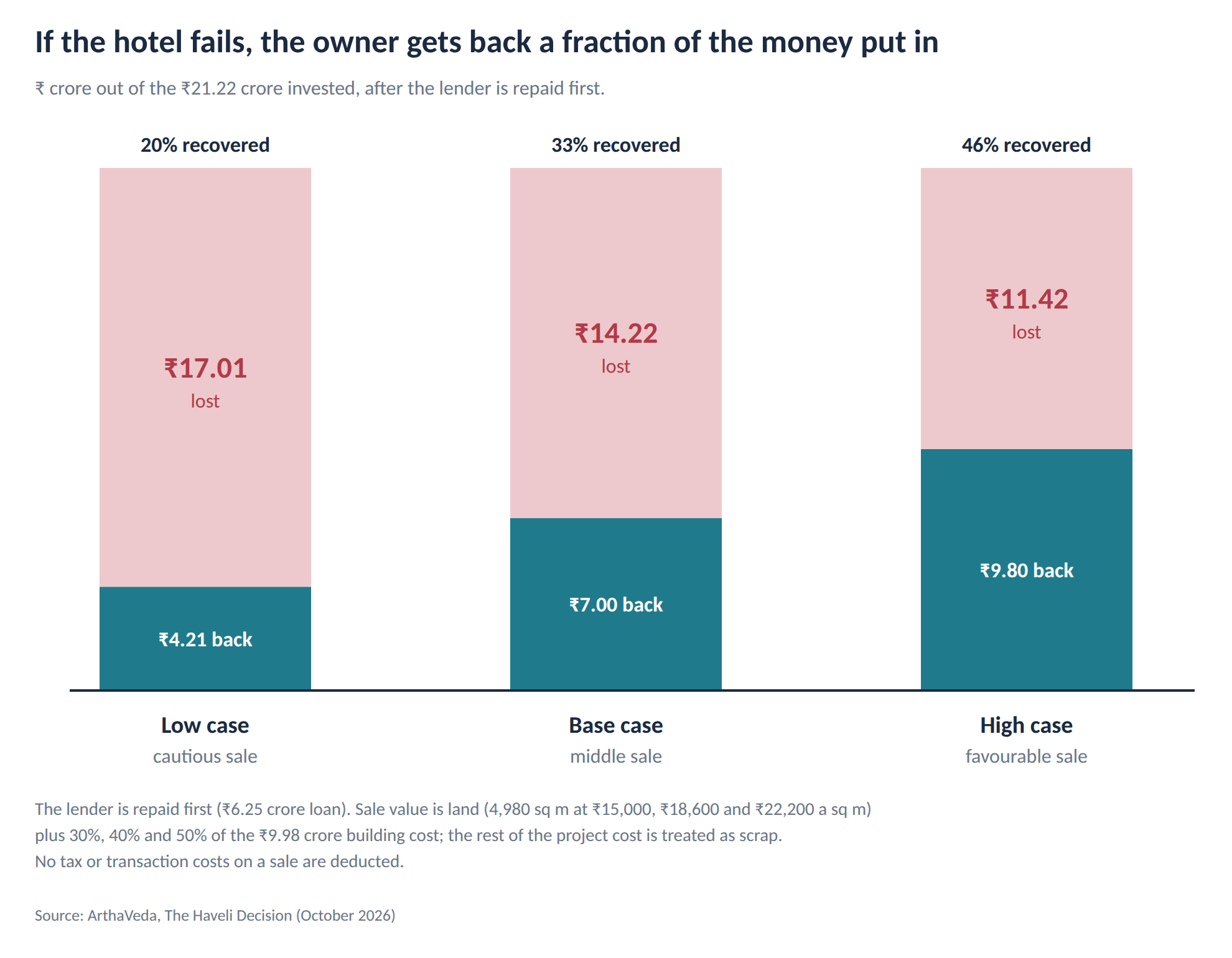
A stacked bar chart of how much of the ₹21.22 crore invested is recovered if the venue is sold: 20%, 33% and 46% across the three cases.
Across the cautious, middle and more favourable sale scenarios, estimated owner losses range from ₹17.01 crore to ₹11.42 crore. Land is the main driver of recovery, at about 70% of sale proceeds in every case, so these figures depend heavily on current market land rates. No tax or transaction costs on a sale are deducted.
The downside is substantial, and the assets may not protect the equity invested. Because the lender is paid first, shareholders absorb the remaining shortfall.
Put the two sides together and the picture is stark. The payoff analysis compares the estimated cash reward with the capital at risk if the project fails. The resulting ratios at the 12.1% standalone hurdle are −0.40x in the low case, −0.02x in the base case and 0.55x in the high case. These figures do not tell us the probability of each outcome; they show how the reward compares with the estimated downside under each scenario.
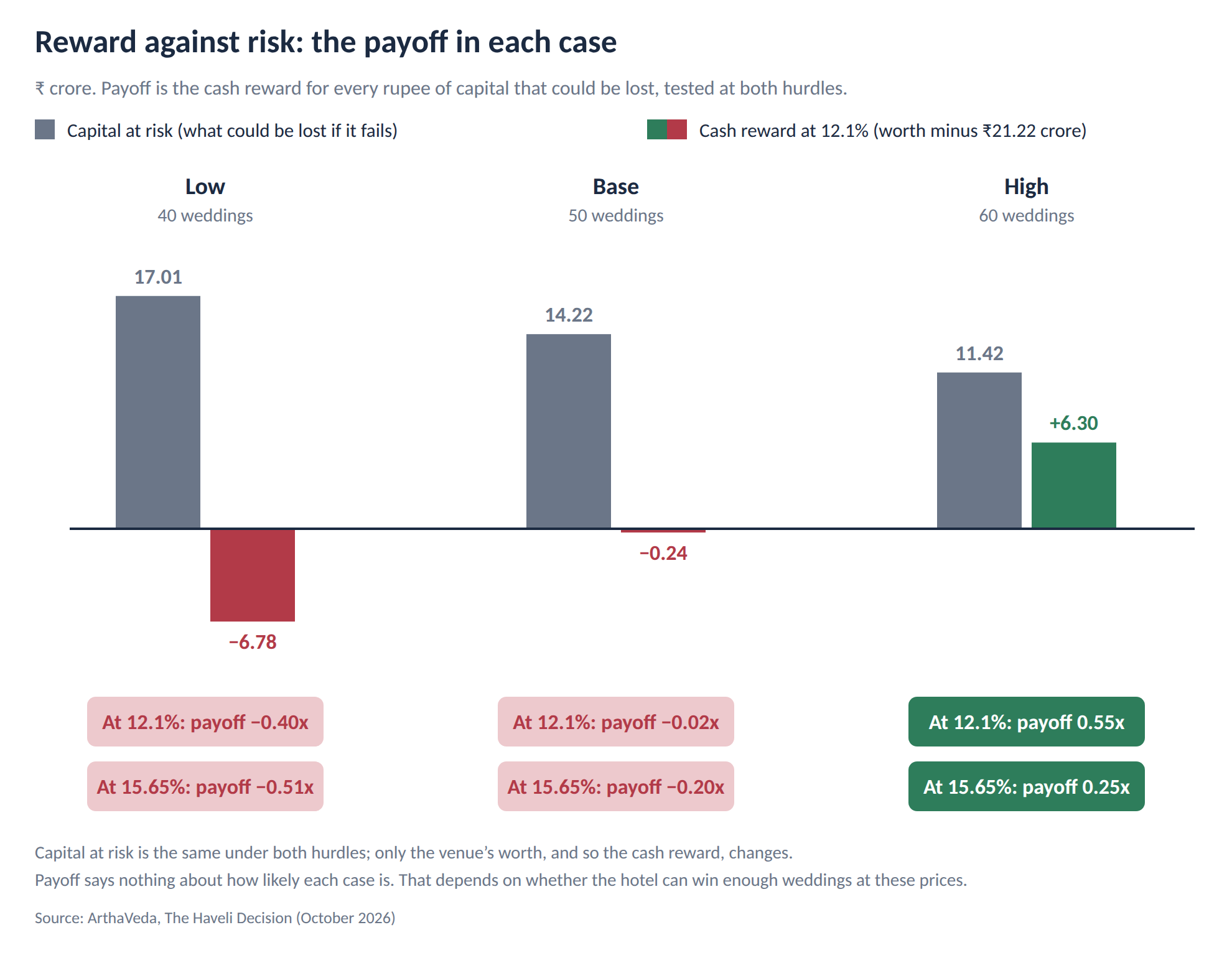
A paired bar chart of capital at risk against cash reward in each case, with payoff ratios at the 12.1% and 15.65% hurdles.
The same test can be run at two hurdles. At the 12.1% standalone hurdle, the question is whether the Haveli earns the cost of the money behind it. At the 15.65% Pind-level hurdle, the question is whether it beats the business Pind already runs. Capital at risk is the same under both; only the venue’s worth, and so the cash reward and the payoff, changes.
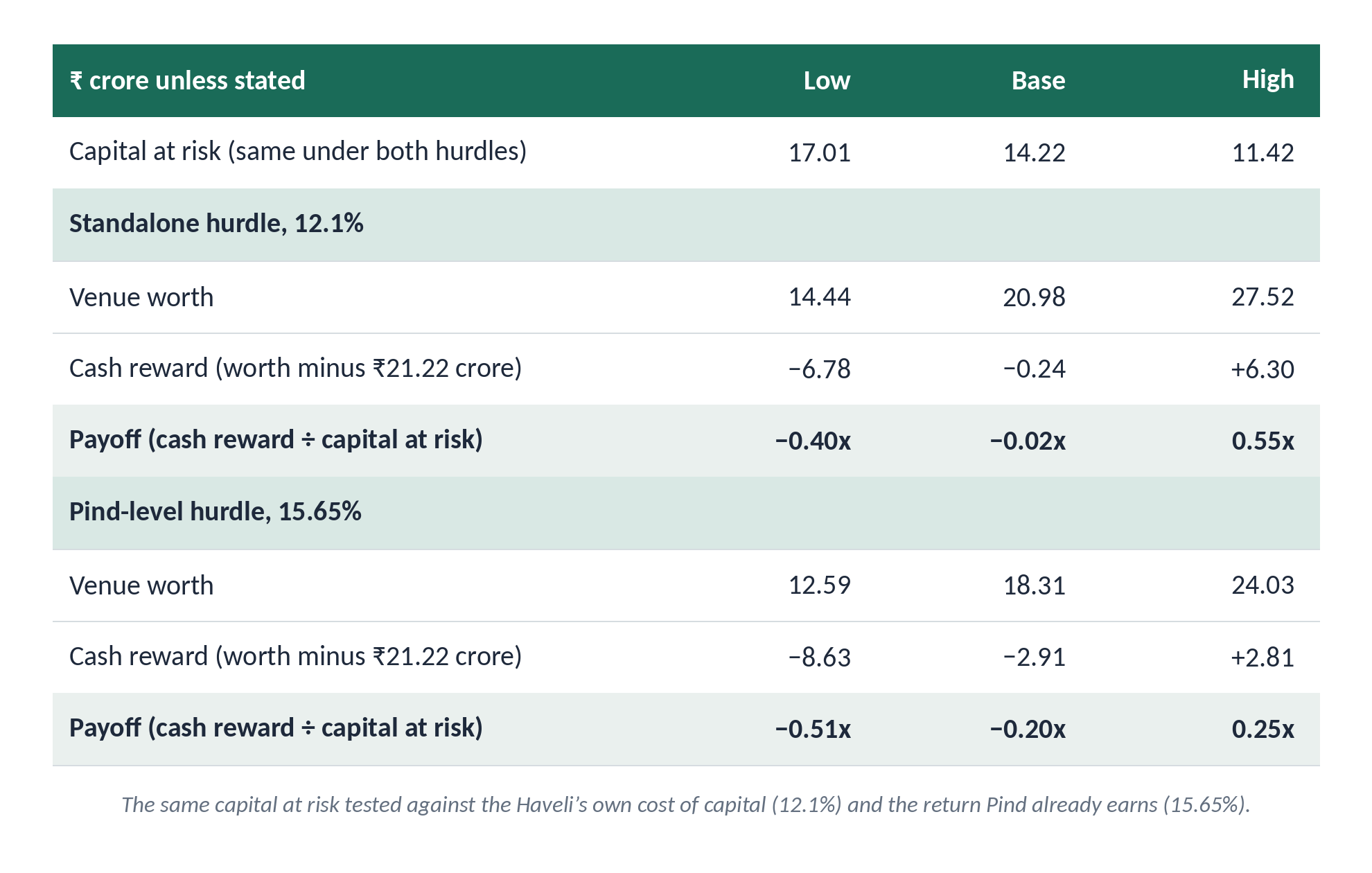
A table testing the Haveli’s capital at risk against the 12.1% and 15.65% hurdles, with payoffs in each of the three cases.
At the stricter Pind-level hurdle, the base case falls ₹2.91 crore short of the money invested and its payoff drops to −0.20x. Only the high case still clears it, at 0.25x.
The high case creates value, but even there the estimated additional reward is smaller than the capital at risk. In the base case, the project is just short of the 12.1% standalone hurdle and well short of the 15.65% Pind-level hurdle. The range of outcomes is wide, and the attractive result depends on delivering several things together: enough weddings, pricing power, adequate regular occupancy and a credible year-five valuation.
That leaves little margin of safety. A project does not become attractive merely because a plausible optimistic scenario exists. The key question is whether the assumptions needed for that scenario are supported by evidence, and whether the downside is tolerable if they fail.
Verdict: The Haveli does not appear to offer an asymmetric payoff. Pind would earn a lower reward for each rupee of risk it takes.
Position Sizing
The Haveli’s scale makes the concerns more serious. As of 31 March 2026, Pind’s balance sheet stood at ₹37.72 crore and pre-IPO shareholders’ funds were ₹14.52 crore. The project costs ₹27.47 crore in total, including ₹21.22 crore of company equity from IPO proceeds and retained earnings.
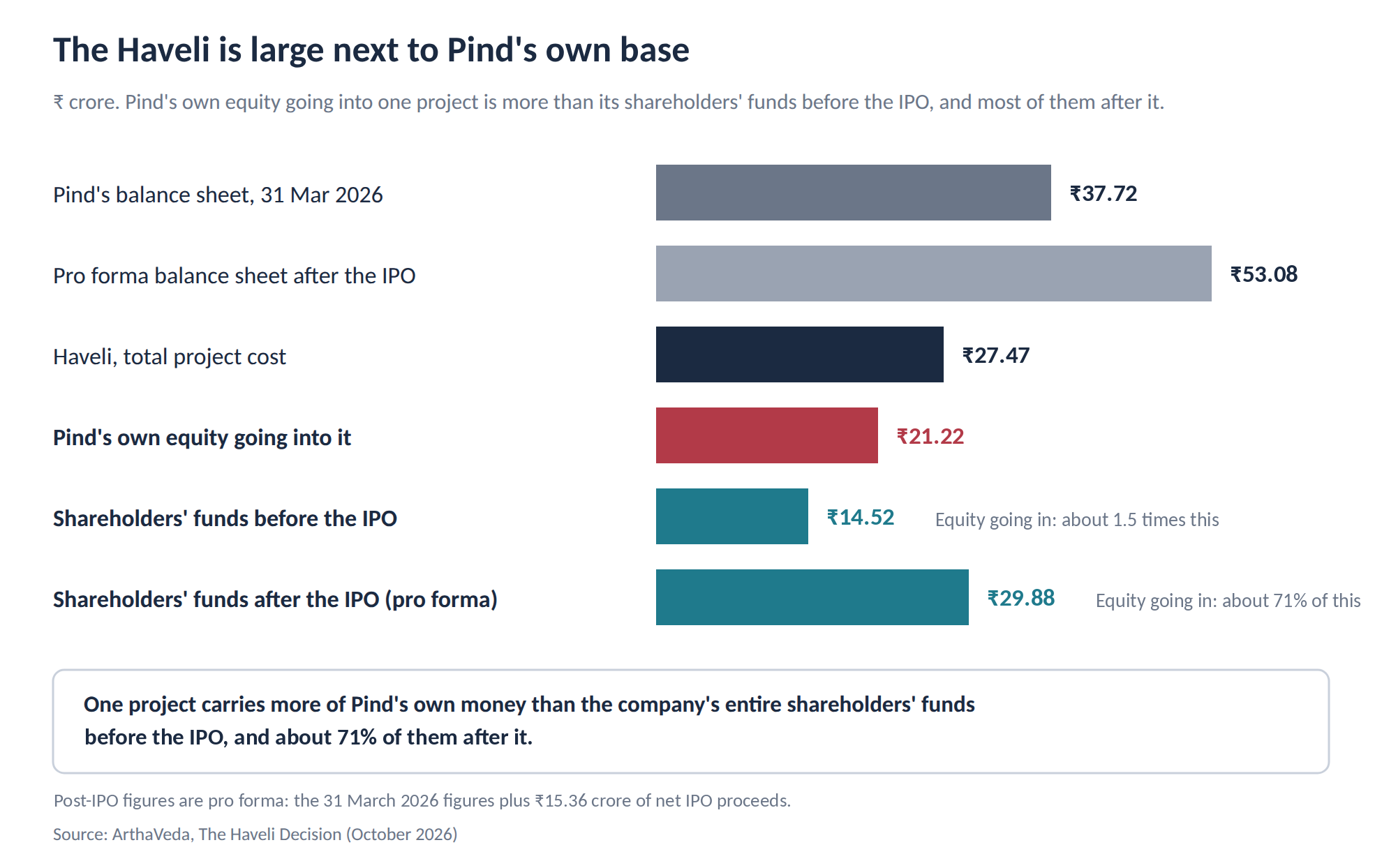
A bar chart comparing the Haveli’s ₹27.47 crore cost and ₹21.22 crore of equity with Pind’s balance sheet and shareholders’ funds before and after the IPO.
Size looks different depending on the base. Before the IPO, ₹21.22 crore of company equity was about 1.5 times shareholders’ funds of ₹14.52 crore. After the IPO, funds are about ₹29.88 crore on a pro forma basis (the pre-IPO figure plus ₹15.36 crore of net proceeds: ₹17.82 crore raised, less ₹2.46 crore of issue expenses), so the same commitment is about 71% of them. The IPO makes the Haveli smaller relative to the company, but it still takes most of its shareholders’ funds.
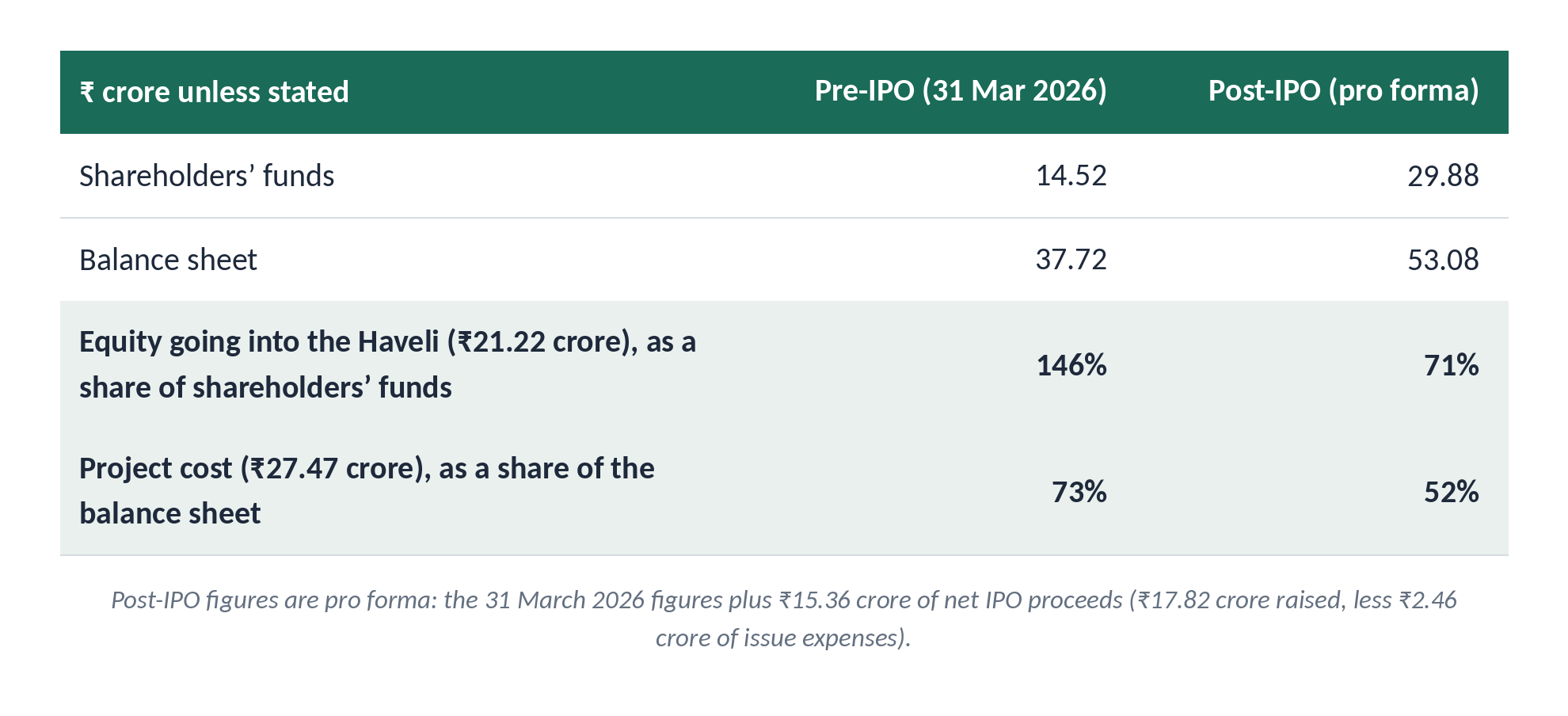
A table comparing the Haveli’s equity (146% of shareholders’ funds before the IPO, 71% after) and project cost (73% of the balance sheet before, 52% after) with Pind’s size.
The equity commitment alone exceeds Pind’s pre-IPO shareholders’ funds. The Haveli is therefore not a small experiment alongside the existing restaurant business; it is a concentrated bet that could become a major driver of future performance.
If it performs well, it could materially improve the company’s results. If it underperforms, it could constrain profitability, financial flexibility and the ability to pursue other opportunities. When the risk-reward profile is already marginal, the size of the commitment matters as much as the business idea itself.
Verdict: The Haveli is too large for Pind’s balance sheet. ₹21.22 crore of company equity is about 1.5 times its pre-IPO shareholders’ funds and about 71% of them even after the IPO, so the size of the commitment adds to the risk.
ArthaVeda’s Advisory note
Pind has done a reasonably good job of sourcing capital. The estimated cost is manageable, the funding has a long enough horizon for a hotel project, and the promoters retain control of the business. The lender’s security and the delayed instalments are important pressure points, but they do not erase the strengths of the financing structure.
Capital allocation is the weaker half of the decision. The Haveli enters a competitive market without a clear moat, ties up capital in a specialised asset, and offers only a marginal result in the base case on the assumptions used for wedding demand, pricing and future value. The project is also disproportionately large relative to Pind’s existing financial resources.
This does not mean the Haveli cannot make money. A profitable business and a good investment are not the same thing. The relevant question is whether the return adequately compensates the owner for the capital committed, the possibility of permanent loss and the opportunities forgone elsewhere.
On the assumptions available, ArthaVeda’s view is that Pind should not have pursued the Haveli at this scale. The concern is not that success is impossible; it is that even success may not deliver a sufficiently attractive return for the risk taken—and that the size of the bet leaves the company exposed if the assumptions do not hold.
A restaurant that has a bad month can recover. The Haveli leaves far less room for one. That is the broader lesson for business owners: raising capital well is only half the job. The harder test is deciding where that capital deserves to go, and how much of the company to put behind it.
Disclaimer
A business view, not an investor view. This report looks at a capital decision from the point of view of the business: how Pind Hospitality raised money and where it chose to put it. It does not take the point of view of an investor, and it does not assess Pind’s shares, their price or their merits as an investment.
Only the Haveli project. The report does not evaluate Pind as a business. It looks only at the Haveli project and the funding behind it. Figures about Pind as a whole, such as its balance sheet and return on equity, are used only as reference points for that decision.
Estimates, not facts. The Favourable Odds and Asymmetric Payoff sections rest on ArthaVeda’s own estimates and assumptions, including wedding volumes, prices, costs, sale values and recovery rates. They are not actual or reported figures, and real outcomes may differ materially.
Cost of equity. The cost of equity of about 11.6% is ArthaVeda’s own way of estimating the cost of equity from the business’s point of view. It is not the return an investor would require, and an investor using a different method would likely reach a different figure.
Disclosure. Neither Trishula Capital nor the author has any relationship with, or holding in, Pind Hospitality.
Not advice. This report is for information and education only. It is not investment, financial, legal or tax advice, and it is not a recommendation or an offer to buy, sell or hold any security. Readers should do their own research and consult a qualified adviser before making any decision.
Sources and accuracy. The analysis is based on publicly available information, mainly Pind Hospitality’s offer document, together with market-based assumptions. ArthaVeda has not independently verified all of this information, and later filings or events may change it. Care has been taken, but no guarantee is given that the information is complete or accurate.
Forward-looking estimates. Projections and scenarios show what may happen under stated assumptions. They are not forecasts or guarantees, and actual results may differ materially.
No liability. ArthaVeda accepts no liability for any loss or damage arising from the use of, or reliance on, this report. The views are as of October 2026, and ArthaVeda is under no obligation to update them.
